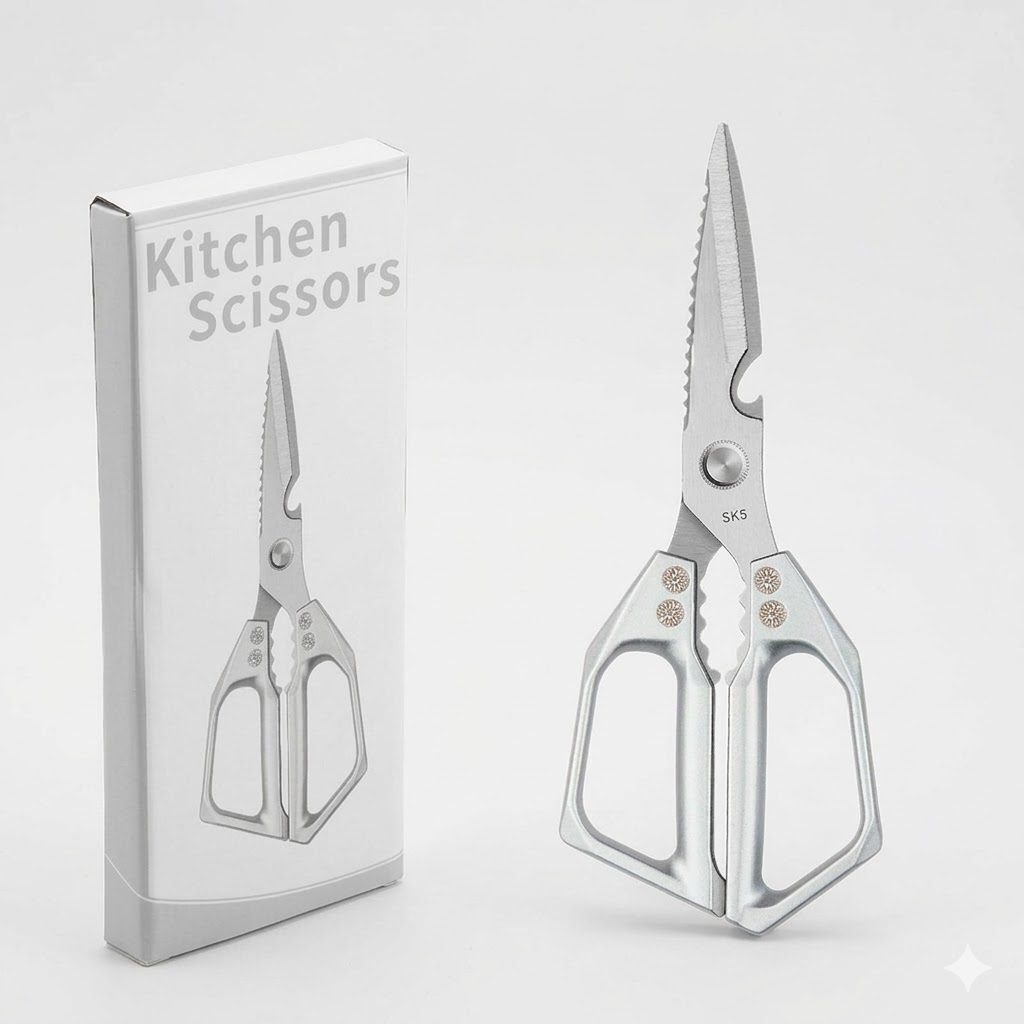
When sourcing kitchen scissors for your business, one of the first questions you’ll face is: should you buy professional-grade or household-quality scissors?
The answer isn’t as simple as choosing the more expensive option. Understanding the real differences between professional and household kitchen scissors—and knowing which features actually matter for your specific use case—can save you from both overpaying for unnecessary features and underbuying products that won’t hold up to your needs.
After decades of working with restaurants, commercial kitchens, retailers, and institutional buyers, we’ve seen the consequences of both mistakes. Let’s break down what actually distinguishes professional kitchen scissors from household versions, and more importantly, what that means for your purchasing decisions.
The Fundamental Difference: Design Intent
Household Kitchen Scissors:
Designed for occasional home use—cutting packaging, trimming herbs, portioning poultry a few times per week. Expected service life: 2-5 years with light use.
Professional Kitchen Scissors:
Built for daily commercial use—cutting through poultry joints, fish, tough packaging, hundreds of times per shift. Expected service life: 3-5 years of heavy daily use, or longer.
This fundamental difference in design intent drives every other distinction between the two categories.
Material Quality: Where the Difference Starts
Blade Steel
Household scissors typically use:
- 2Cr13 or 3Cr13 stainless steel
- Adequate corrosion resistance
- Moderate hardness (HRC 52-54)
- Acceptable edge retention for light use
- Lower manufacturing cost
Professional scissors typically use:
- 4Cr13, 5Cr15MoV, or higher-grade stainless
- Superior corrosion resistance
- Higher hardness (HRC 54-58)
- Better edge retention under heavy use
- More expensive but longer-lasting
What this means in practice:
A household scissor might need resharpening after 3-6 months of daily commercial use. A professional scissor maintains its edge for 12-18 months under the same conditions.
For a busy restaurant cutting poultry 50 times per day, that’s the difference between sharpening every quarter versus once a year—significant time and labor savings.
The cost difference: Professional-grade steel typically adds $1-3 per unit in manufacturing cost, but can double or triple the useful service life.
Handle Materials
Household scissors:
- Standard plastic or basic rubber grips
- Minimal ergonomic design
- May become slippery when wet
- Can crack or degrade with frequent sanitization
Professional scissors:
- High-grade polymers designed for commercial kitchens
- Ergonomic designs tested for extended use
- Textured grips that work when wet or greasy
- Resistant to commercial sanitizers and dishwashers
- Often feature antimicrobial additives
Why it matters:
In commercial settings, scissors get washed dozens of times daily and are handled with wet or greasy hands. Handles that become slippery or degrade create safety issues and need replacement.
Construction Quality: Built to Last vs. Built to a Price
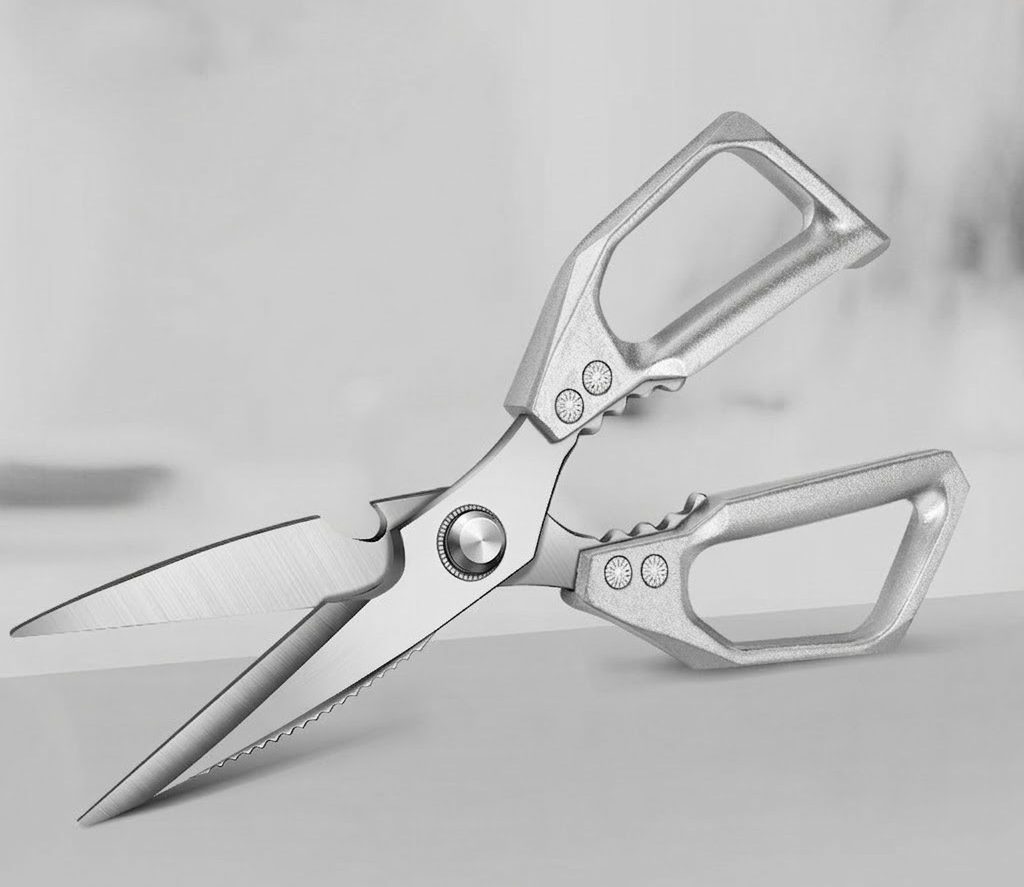
Blade Assembly
Household scissors:
- Often use simple riveted construction
- Blades may not be individually replaceable
- Pivot points can loosen with heavy use
- Minimal adjustment capability
Professional scissors:
- Precision-engineered pivot mechanisms
- Adjustable tension in better models
- Some designs allow blade replacement
- Built to maintain alignment under stress
The practical impact:
When scissors are used hundreds of times daily, minor manufacturing tolerances that don’t matter in home use become critical. Professional scissors are built to tighter tolerances to maintain proper blade alignment and cutting efficiency over time.
Blade Edge Geometry
Household scissors:
- Standard grind angles suitable for general use
- May have micro-serrations for grip
- Adequate for soft materials
Professional scissors:
- Often feature precision-ground edges
- May include specialized grinds for specific tasks
- Better edge geometry for clean cuts through tougher materials
- Some models offer different edge styles (straight, micro-serrated, or combo)
Example:
When cutting through poultry joints, a properly ground professional scissor makes clean cuts without crushing bone or tearing meat. A household scissor doing the same task may crush or tear, reducing presentation quality.
Special Features: What’s Standard vs. Premium
Features Common in Professional Models:
Bone notch:
- Specialized cutting area near the pivot for cutting through small bones
- Not typically found on household scissors
- Essential for poultry processing
Bottle opener/lid grip:
- Integrated tools for kitchen tasks
- More robust construction than household versions
- Designed for commercial frequency of use
Dishwasher safe (truly):
- Household scissors may be labeled dishwasher safe but degrade with frequent commercial washing
- Professional models built for daily commercial dishwasher cycles
- Materials and construction resistant to high heat and harsh detergents
Take-apart design:
- Some professional models can be disassembled for thorough cleaning
- Critical for food safety compliance in commercial settings
- Allows for more effective sanitization
Performance Under Real-World Conditions
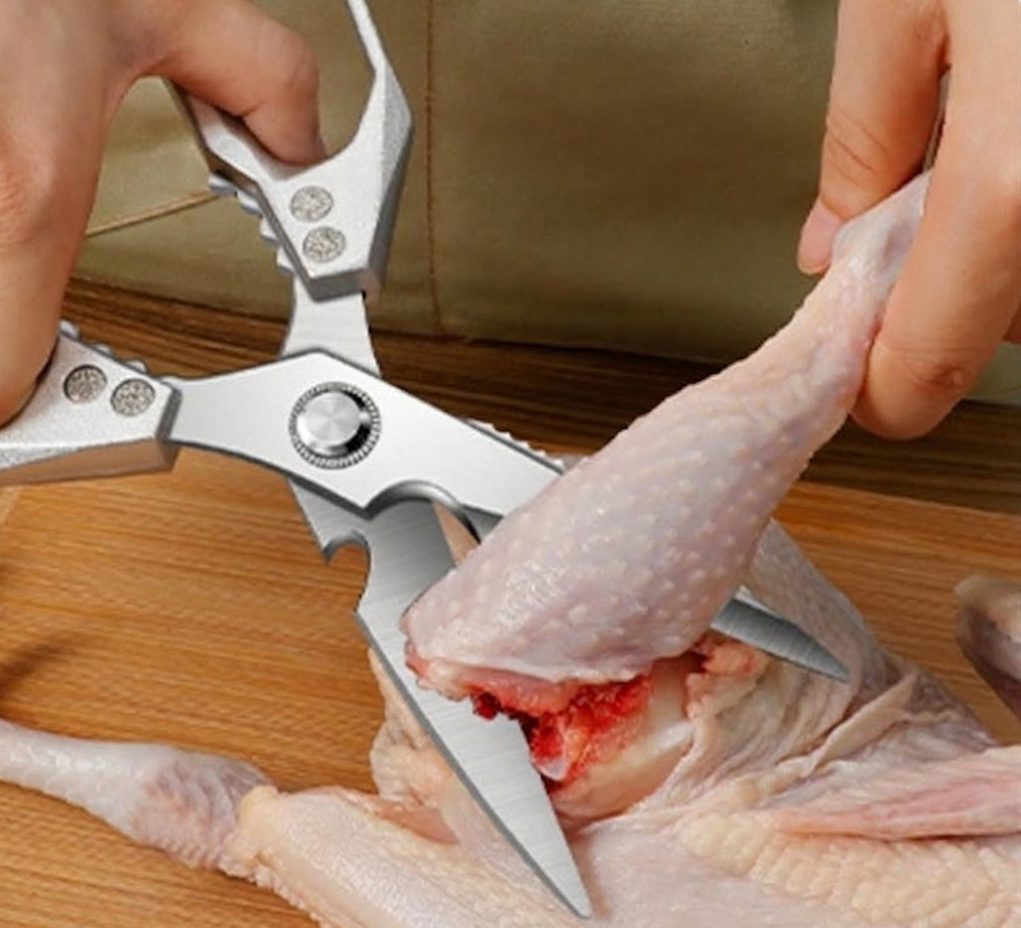
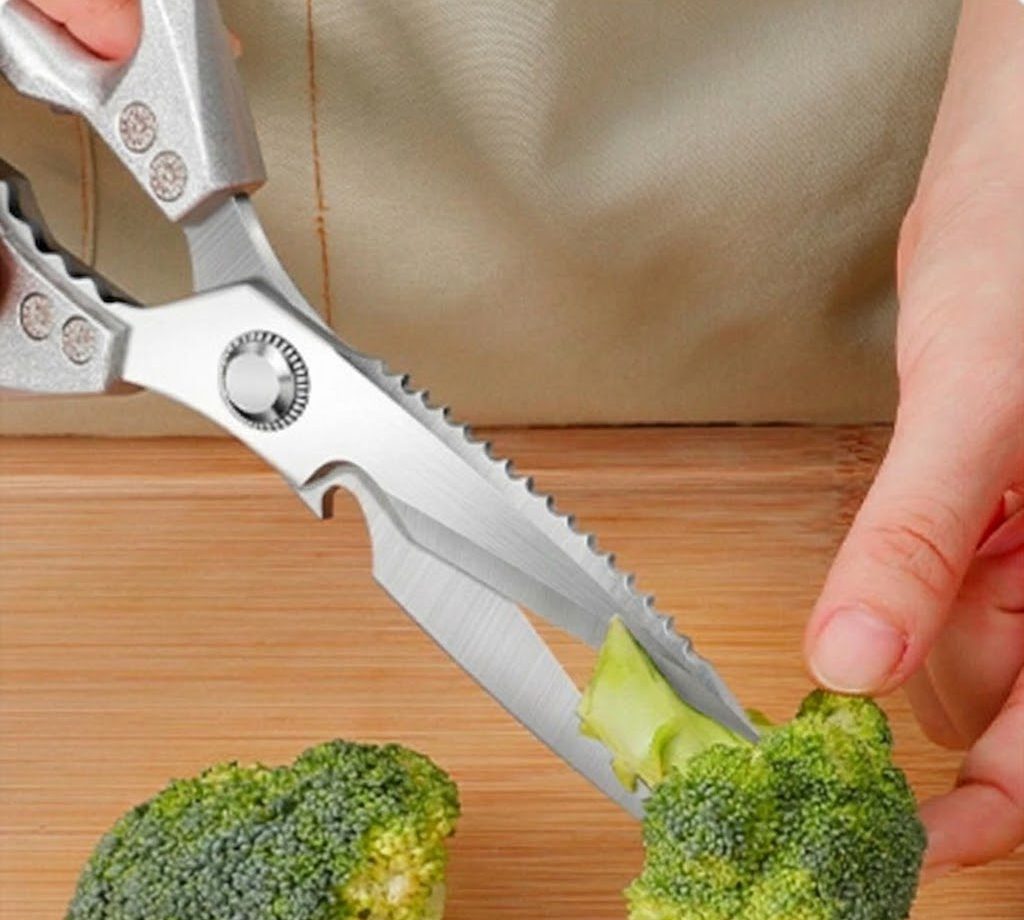

Let’s look at how these differences play out in actual use:
Scenario 1: Restaurant Kitchen
Task: Cutting raw chicken 40-60 times per day, plus general prep work
Household scissors:
- Begin showing edge degradation after 2-3 months
- Handles may become slippery or crack
- Pivot loosens, affecting cutting precision
- Replacement needed every 6-12 months
- Annual cost: 2-4 scissors @ $8-15 each = $16-60
Professional scissors:
- Maintain sharp edge for 12+ months
- Handles remain intact and grippy
- Pivot maintains tension and alignment
- Replacement needed every 2-3 years
- Annual cost: 0.3-0.5 scissors @ $25-40 each = $8-20
Result: Professional scissors cost less per year despite higher upfront price, plus save staff time and frustration.
Scenario 2: Retail Product Line
Context: Selling kitchen scissors to consumers through retail channels
Household quality:
- Lower price point ($10-20 retail)
- Adequate for target market (home cooks)
- Higher volume potential
- Some risk of early failures leading to returns
Professional quality:
- Higher price point ($30-60 retail)
- Smaller market (serious home cooks, semi-pro)
- Lower volume but higher margins
- Lower failure/return rates
- Premium positioning
Consideration: Market positioning matters. Professional-quality scissors in retail appeal to serious home cooks willing to pay for durability, but the mass market may find them overpriced for their needs.
Scenario 3: Institutional Purchasing
Context: Outfitting a school cafeteria, hospital kitchen, or catering operation
Key factors:
- Budget constraints
- Durability needs (high-volume use)
- Replacement logistics
- Staff skill levels
Analysis:
Institutional buyers often benefit most from professional-grade scissors:
- Lower total cost of ownership over 3-5 years
- Fewer replacements reduce procurement overhead
- Better performance reduces staff frustration
- Longer service life means less downtime
However, the upfront budget allocation may favor household scissors initially, leading to higher long-term costs—a common institutional purchasing paradox.
The Gray Area: “Commercial Grade” Marketing
Buyer beware: Many scissors marketed as “commercial” or “professional grade” fall somewhere between true household and professional quality.
Warning signs of inflated claims:
- “Commercial grade” with 2Cr13 steel — True professional scissors rarely use the lowest-grade stainless
- No specific hardness rating — Professional manufacturers typically specify HRC ratings
- Vague construction details — Quality makers describe their construction methods
- Price too good to be true — Genuine professional scissors have higher material and manufacturing costs
Questions to ask:
- What specific steel grade is used?
- What is the blade hardness (HRC rating)?
- Is this designed for daily commercial use or occasional home use?
- What’s the expected service life under heavy use?
- Can you provide references from commercial users?
Reputable suppliers will answer these questions directly. Evasive answers suggest the “professional” label is marketing rather than specification.
Making the Right Choice for Your Needs
Choose household-quality scissors when:
- Selling to mass-market retail — Most home cooks don’t need professional durability
- Light institutional use — Office kitchens, light food prep areas
- Budget is primary constraint — Accepting more frequent replacement as tradeoff
- Low-volume use — Occasional cutting tasks that don’t justify premium cost
Choose professional-quality scissors when:
- Commercial kitchen use — Restaurants, catering, food processing
- High-volume operations — Any setting with daily, intensive use
- Food safety critical — Settings requiring frequent sanitization
- Total cost matters more than upfront cost — Longer service life reduces replacement frequency
- Premium retail positioning — Targeting serious home cooks or professional home users
Consider mid-grade options when:
- Budget and durability both matter — Institutional settings with moderate use
- Retail positioning — “Better” tier between basic and premium
- Testing the market — Initial offering before committing to premium positioning
Specifications That Actually Matter
When evaluating scissors, focus on specifications that impact real-world performance:
Critical specifications:
- Steel grade and hardness (HRC)
- Directly impacts edge retention and longevity
- Should be clearly stated, not vague
- Handle material and design
- Affects comfort, safety, and durability
- Consider your specific use environment (wet, greasy, frequent washing)
- Pivot construction
- Quality of the joint affects long-term performance
- Adjustable pivots offer advantage in professional use
- Blade length and overall dimensions
- Match to intended tasks
- Commercial kitchens often prefer 8-9 inch overall length
Less critical specifications:
- Fancy packaging — Adds cost without adding performance
- Too many “features” — Built-in tools rarely get used; focus on core scissor quality
- Decorative elements — Color, patterns, etc. don’t affect performance
The Hidden Cost Factor: Training and Familiarity
One often-overlooked consideration: staff familiarity and training.
Professional-quality scissors:
- May feel different than home scissors
- Staff accustomed to cheap scissors might not notice quality difference initially
- Proper use and maintenance extends service life
Recommendation: When upgrading to professional scissors in commercial settings, brief training on proper use and care maximizes the investment. Simple practices like hand-washing instead of tossing in the dishwasher can significantly extend service life.
Regional Standards and Expectations
Different markets have different expectations for “professional” quality:
European markets:
- Often expect higher-grade materials and construction
- Certifications (LFGB) indicate quality compliance
- Price sensitivity lower for professional equipment
North American markets:
- Balance between quality and value
- FDA compliance expected for food-contact items
- Growing appreciation for durability over cheap replacement
Asian markets:
- Highly varied by segment
- Premium segment values Japanese or German quality standards
- Mass market very price-sensitive
Implication for buyers: When sourcing for specific markets, understand regional expectations. What’s considered “professional” in one market might be mid-grade in another.
Quality Control Considerations
Professional and household scissors require different quality control approaches:
For household scissors:
- Focus on basic functionality and safety
- Acceptable defect rates can be slightly higher
- Visual quality important for retail appeal
For professional scissors:
- Stringent functional testing
- Lower acceptable defect rates
- Consistency critical (commercial users buy repeatedly)
- Performance under stress testing important
Testing recommendations:
- Cutting performance — Test on materials similar to intended use
- Edge retention — Accelerated use testing
- Handle durability — Stress testing, sanitizer resistance
- Corrosion resistance — Salt spray testing for steel quality
The Bottom Line: Match Quality to Application
The “best” kitchen scissors aren’t always the most expensive professional models. The best scissors for your needs are those that:
- Match your use case — Don’t overbuy features you won’t use
- Fit your budget over time — Consider total cost, not just purchase price
- Meet your market’s expectations — Align with customer quality perceptions
- Offer reliable supply — Consistent quality across orders matters
For commercial users: Professional-quality scissors almost always prove more economical over time, despite higher upfront costs.
For retail buyers: Understand your market segments. Offer both household and professional options to serve different customer needs and price points.
For institutional buyers: Calculate total cost of ownership over expected product lifetime, not just unit price. Professional scissors often win this analysis.
Sourcing Considerations
When sourcing either category:
Verify actual specifications:
- Don’t rely on marketing claims
- Request detailed material specifications
- Test samples under real-world conditions
Understand the supply chain:
- Professional scissors often come from specialized manufacturers
- Household scissors may be mass-produced with less specialization
- Source matters for quality consistency
Build relationships:
- Suppliers with deep manufacturing knowledge can guide specifications
- Long-term partnerships ensure quality consistency
- Local expertise (like Hangzhou’s scissor-making tradition) provides access to specialized manufacturers
Making an Informed Decision
Understanding the real differences between professional and household kitchen scissors empowers better purchasing decisions:
- For your business operations — Buy appropriate quality for actual needs
- For your product line — Position and price according to genuine value
- For your budget — Optimize total cost, not just purchase price
The gap between professional and household scissors is real and measurable—in materials, construction, performance, and service life. The question isn’t which is “better” in absolute terms, but which better serves your specific needs.
Need Help Specifying the Right Kitchen Scissors?
Whether you’re outfitting a commercial kitchen, building a retail product line, or making institutional purchasing decisions, choosing the right quality level matters.
Contact us to discuss your specific requirements:
- Email: amy.chen@zhangtools.com
- WhatsApp: +852 93733314
With deep roots in Hangzhou’s scissor manufacturing industry, we can help you navigate the quality spectrum and match specifications to your actual needs—no overselling, no underselling, just the right fit for your application.
Professional Quality Starts with Understanding the Difference